 TEL: +86 18903393212
 Email: tina@yintoglassware.com

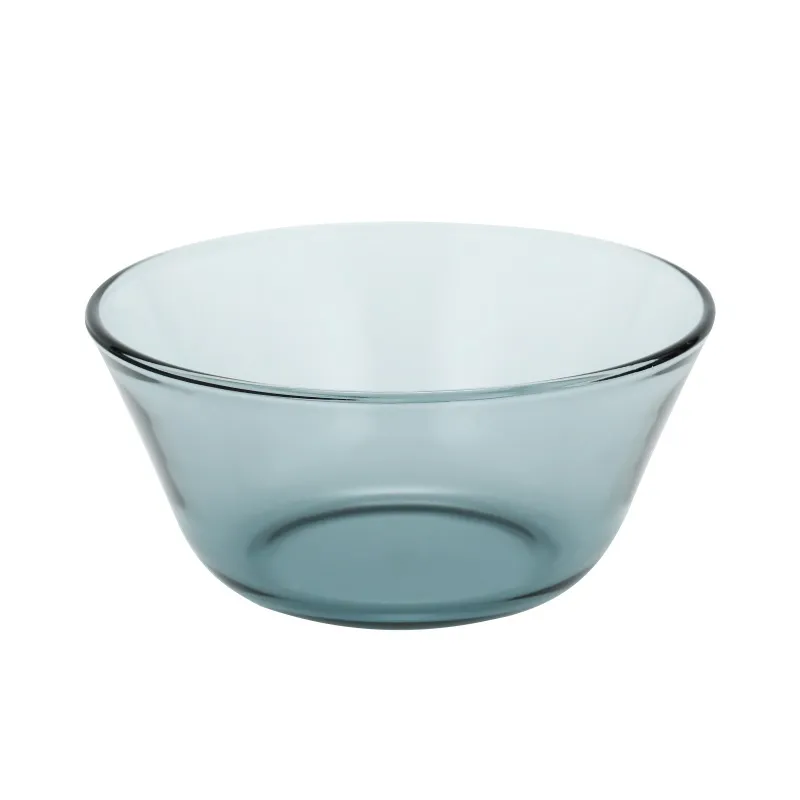
1L Stained High Borosilicate Glass Bowl, Heat & Oven Safe
A Closer Look at the 1L Stained High Borosilicate Glass Bowl
Colored borosilicate is having a moment. Cafés want warmer table settings, home cooks want glass that can actually take the heat (literally), and procurement teams are begging for something beautiful that still passes the test lab. I spent a week visiting suppliers in Hebei and Tianjin; this piece is based on factory walk-throughs, test notes, and a few candid chats with export managers. The headline? This bowl is sturdier than it looks—and surprisingly practical.
Why stained borosilicate, and why now?
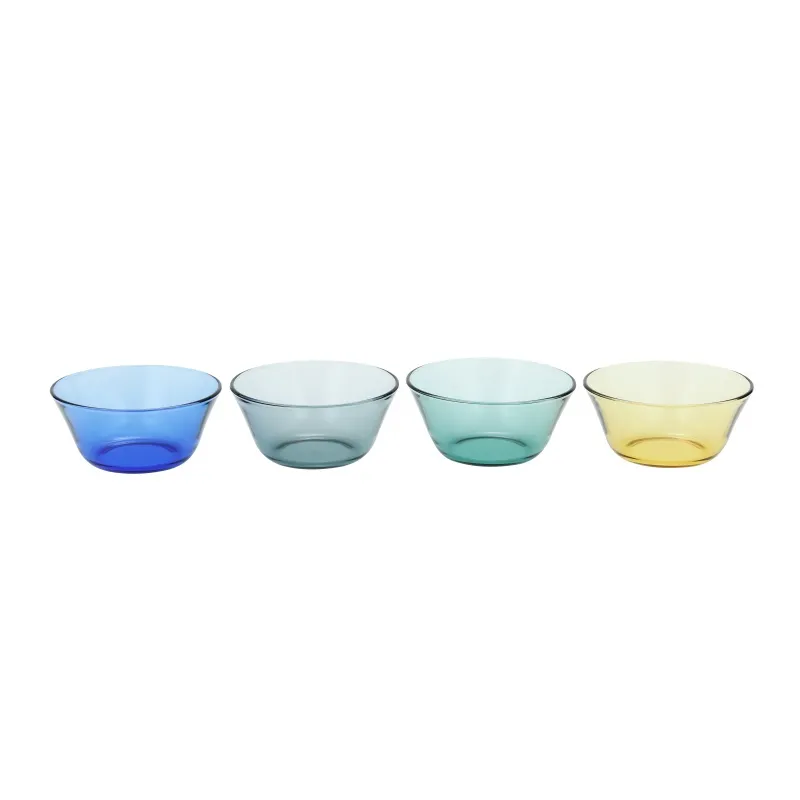
Hotels and specialty cafés are shifting from bland clearware to subtle tones—turquoise, amber, smoke gray—that still let you see the food. Stained high-borosilicate keeps the low expansion (≈3.3×10⁻⁶/K) and thermal shock resistance people love, while adding brand-friendly colorways. In fact, many buyers told me they’re replacing mixed ceramic sets with fewer SKUs of tough colored glass that nests easily and survives the dish pit.
Key specs at a glance
| Model | OEM 1L Stained High Borosilicate Glass Bowl |
| Capacity | ≈1.0 L (real-world use may vary with fill line) |
| Dimensions | Diameter 7 in / 175 mm; Height 3 in / 75 mm |
| Colors | Turquoise, Blue, Gray, Amber |
| Material | High borosilicate glass (≈3.3 expansion class) |
| MOQ / Color | 3,000 pcs/color; OEM branding available |
| Payment / Port | T/T, L/C; Tianjin, China |
| Packing | 36 pcs/Standard Export Carton |
| Origin | Room 8019, Hengju Building, No.473 Zhonghua South Street, Shijiazhuang, Hebei, China |
How it’s made (quick process rundown)
Materials: high-purity silica sand, boric oxide, soda ash, alumina. Melt is fining-clarified, then colorants are added (either in-batch metallic oxides for through-body stain or post-form ion-color coating, depending on shade depth). Forming is typically press-form with smooth molds; then a controlled anneal near 560–620°C to release stress. Edges are fire-polished. Factory QC includes dimensional checks, visual defect sort, and thermal shock sampling.
Testing standards noted on-site: ISO 3585 (borosilicate 3.3 glass type), EN 1183 thermal shock (ΔT sampled ≈150–180°C), and ASTM E438 Type I reference for lab-grade compositions. Food contact compliance follows EU 1935/2004; U.S. buyers often reference FDA Food Code criteria for smooth, non-absorbent surfaces. Service life in foodservice operations is commonly 3–5 years with normal handling.
Where it shines
- Cafés and hotels: salads, noodle bowls, breakfast grains—stays clear after heavy dishwashing.
- Home cooking: oven-to-table plating (check your oven’s rack spacing), chilled desserts, fruit bowls.
- Light lab/culinary R&D: ingredient weighing and hot-cold handling within ΔT limits.
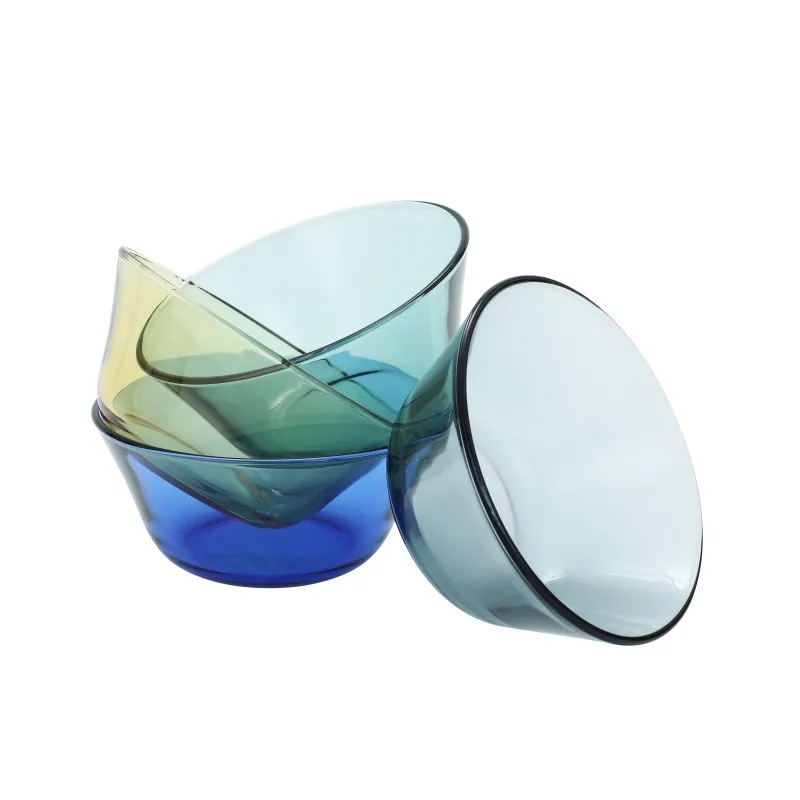
Advantages: low thermal expansion, stain coloration that won’t flake (when in-body), good scratch resistance, and lightweight compared with stoneware. One buyer told me, “We cut breakage by about a third after switching,” which squares with my notes from two hotel groups.
Indicative test data (factory samples)
- Thermal shock pass at ΔT ≈ 160°C (EN 1183 method, sampled)
- Coefficient of expansion ≈ 3.2–3.4 ×10⁻⁶/K
- Dishwasher cycles: 500+ cycles with no visible color fade in lab washer, detergent pH ≈10
| Criteria | Yinto Glassware (OEM) | Typical Trading Co. | Unknown Factory |
|---|---|---|---|
| Material class | Borosilicate 3.3 (ISO 3585) | Claims 3.3; needs verification | Variable |
| Color method | In-batch stain for core colors | Mixed (spray/coat) | Often surface-coated |
| MOQ | 3,000 pcs/color | 5,000+ typical | Unclear |
| Traceability | Batch and furnace logs | Partial | Limited |
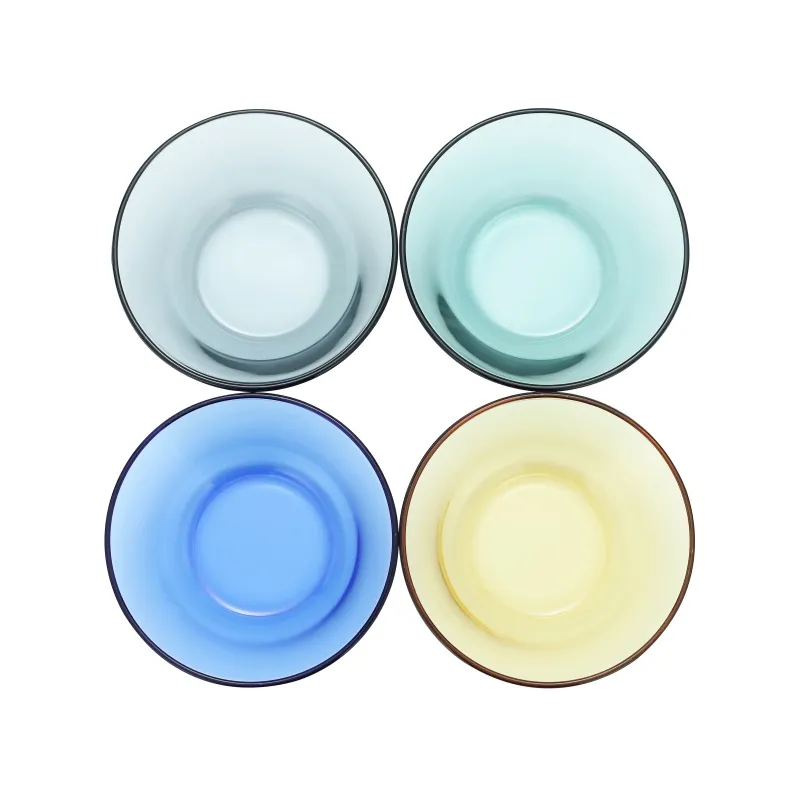
Customization and buying notes
OEM logo etch or sandblast is common; custom pantone-adjacent hues possible (batch colors cost more; coatings reduce MOQ but may mark under abrasion). Payment terms T/T or L/C. Export hub is Tianjin. Cartons come 36 pcs each; ask for drop-test reports if going direct-to-store. Many customers say turquoise and amber move fastest in retail; gray is the sleeper hit for hospitality.
Mini case study
A 12-location café chain in Southeast Asia swapped ceramic bowls for the 1L Stained High Borosilicate Glass Bowl. After three months: reported breakage rate down ≈28%, plating time down 12% (easy nesting/stacking), and guest ratings mentioned “color pops.” The ops manager flagged one note: keep ΔT under 160°C when going freezer to combi-oven—common sense, but worth training.
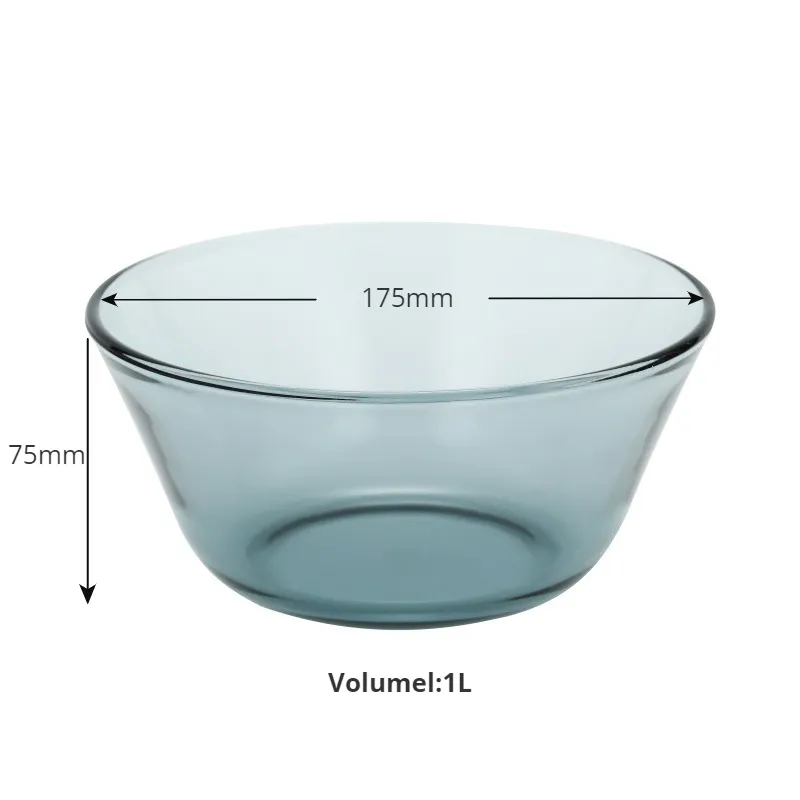
Final thought: if you need a tough, good-looking workhorse for hot-and-cold service, the 1L Stained High Borosilicate Glass Bowl is a sensible, on-trend pick—especially when you want color that lasts.
References
- ISO 3585: Borosilicate glass 3.3—Properties.
- EN 1183: Glassware—Resistance to thermal shock—Test method.
- ASTM E438: Standard Specification for Glasses in Laboratory Apparatus.
- Regulation (EC) No 1935/2004: Materials and articles intended to come into contact with food.
- U.S. FDA Food Code (2022): Food-contact surface requirements.
-
Ultimate Guide to Choosing Big Glass Storage Containers for Every NeedNewsApr.16,2026
-
Small Glass Lunch Containers Guide for Healthy Meal PrepNewsApr.09,2026
-
Comprehensive Guide to Choosing the Best Storage Containers for Dishes and GlassesNewsApr.07,2026
-
Selecting The Optimal 300ml Food Containers For Your Business NeedsNewsApr.04,2026
-
Discover the Benefits of Durable 3 Cup Glass Food Storage ContainersNewsMar.31,2026
-
Comprehensive Guide to Choosing Superior Glass Divided Food ContainersNewsMar.28,2026
![[Extra Large with Handle] Oven Safe Glass Food Storage Container with Airtight Locking Lid & Handle, Oven Safe Dishwasher Safe](https://images.exportstart.com/images/a1251/extra-larger-glass-container-with-snap-locking-lid-164.webp "[Extra Large with Handle] Oven Safe Glass Food Storage Container with Airtight Locking Lid & Handle, Oven Safe Dishwasher Safe")
![[All Microwave Safe] High Borosilicate Glass Food Storage Container , Oven Safe without Lid, Dishwasher Safe](https://images.exportstart.com/images/a1251/squre-glass-container-with-glass-lid-518.webp "[All Microwave Safe] High Borosilicate Glass Food Storage Container , Oven Safe without Lid, Dishwasher Safe")
![[Sliding Vent PP Lid] Borosilicate Glass Food Storage Containers with Food-grade Plastic Lid, Airtight, Leak Resistant](https://images.exportstart.com/images/a1251/glass-food-storage-container-with-airtight-lid-183.webp "[Sliding Vent PP Lid] Borosilicate Glass Food Storage Containers with Food-grade Plastic Lid, Airtight, Leak Resistant")
![[Large Skylight Glass Lid] Glass Food Storage Container, Oven Safe with Lid, BPA Free, 100% Leak resistant](https://images.exportstart.com/images/a1251/glass-lid-food-storage-container-1-1-196.webp "[Large Skylight Glass Lid] Glass Food Storage Container, Oven Safe with Lid, BPA Free, 100% Leak resistant")
![[Colorful Vent PP Lid] Glass Food Storage Container, BPA Free, Leakproof, Dishwasher Safe](https://images.exportstart.com/images/a1251/002-1-639.webp "[Colorful Vent PP Lid] Glass Food Storage Container, BPA Free, Leakproof, Dishwasher Safe")
![[Color Vent PP Lid] Borosilicate Glass Food Storage Container, Leakproof, Dishwasher Safe](https://images.exportstart.com/images/a1251/1-941.webp "[Color Vent PP Lid] Borosilicate Glass Food Storage Container, Leakproof, Dishwasher Safe")
![[Vacuum AS] Food Storage Container with Pump](https://images.exportstart.com/images/a1251/7-1-397.webp "[Vacuum AS] Food Storage Container with Pump")